

Recently, the public witnessed the devastating impact of floods on Cebu. These floods swept into settlement areas, not only along the riverbanks but also into planned areas.
Various commentaries have been made regarding the reasons behind such a scale of flooding. Many pointed to the improper and insufficient flood control projects as the main reasons.
Pending formal inquiries, reports, and videos circulating on social media indicate several factors that could have contributed to the massive flooding. These include unusually high rainfall caused by Typhoon Tino, deforestation of upland areas, limited carrying capacity of water channels (both natural and man-made), settlements located in critical areas, easements and no-build zones, blocked drainage, physical obstructions at lowlands, and high tide and tidal surge. These factors demonstrate that events in the uplands and coastlines have significant impacts on the areas in between.
Ridge-to-Reef
The Ridge-to-Reef approach views watersheds to the coasts as a single, interconnected ecosystem. This holistic perspective emphasizes the importance of planning beyond isolated areas or projects to consider comprehensive ecosystem-based adaptation. For instance, the loss of forest and vegetation on the ridges has a cascading effect on the downstream areas.
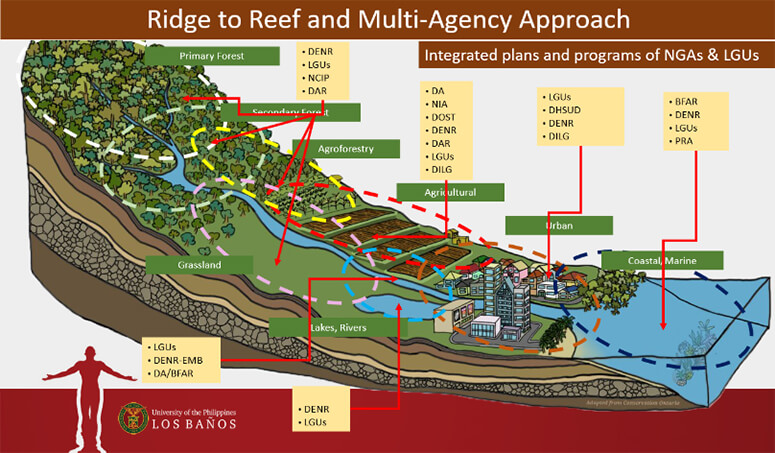
Water surface runoff, a primary cause of most soil erosion and flooding, originates at the watershed’s ridges. To mitigate these issues, interventions should commence in these areas. Staggered contour trenches and afforestation reduce, disperse, and absorb rainwater. This approach controls water at its source, reduces runoff volume and velocity, and prevents floods and heavy sediment destruction in downstream areas.
DHSUD Context
The Department’s “Resilient and Green Human Settlements Framework” (RGHSF) and “Urban Planning and Design for Climate Resilience” serve as the policy foundations for integrating climate resilience and livability into land use and urban planning. Comprehensive Land Use Plans (CLUPs) of local government units (LGUs) must be updated and risk-informed. This approach tries to achieve balanced, interconnected, and climate-responsive development by undertaking climate disaster risk assessment, integrating climate change adaptation, and embedding disaster risk reduction into spatial planning.
DHSUD’s Plan and Do (Planado) Program aims to assist LGUs in developing risk-informed land use and development plans. This program also seeks to enhance LGUs’ institutional capacity, promote digital transformation, and address gaps between planning and implementation.
To accomplish these objectives, the program prioritizes integration by using hydro-geological data and harnessing technologies. The program’s goal is to facilitate data-driven decision-making regarding land uses.
Furthermore, the Planado Program advocates for implementing resilient urban design and development strategies, such as incorporating nature-based solutions like expanding green spaces, planting more trees, and revitalizing aging districts within existing settlements. It also recommends controlled development in high-risk zones, such as watershed areas, steep slopes, and riverbanks, as deforestation and improper land-use practices have detrimental effects on both uplands and lowlands. These strategies endeavor to adapt to the changing climate and evolving needs of our people.
In essence, the Ridge-to-Reef approach embodies a holistic planning philosophy, emphasizing a cause-and-effect perspective. This approach is crucial for environmental management to achieve safe, sustainable, and resilient human settlements.
#PropertyReportFeature
#FeaturedStory
