

Once seen as a modest building material, bamboo is experiencing a revival in the Philippines—as a cornerstone of sustainable design and a renewed expression of Filipino identity.
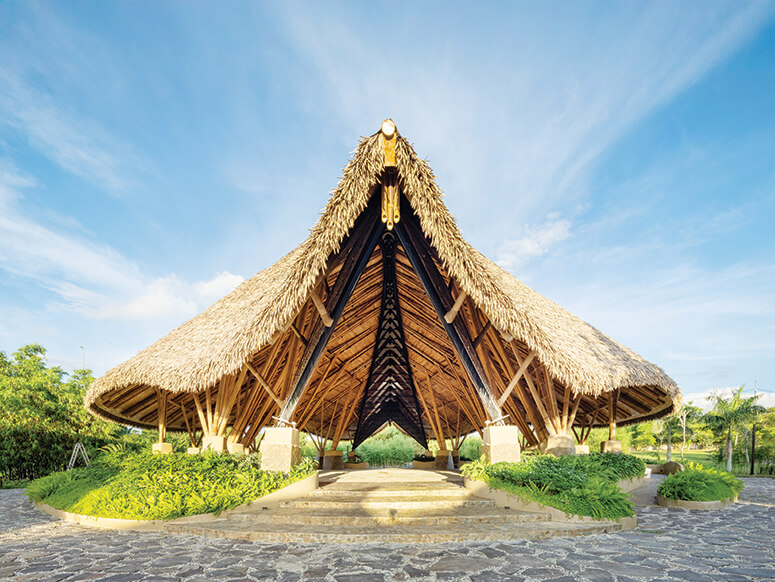
In General Trias, Cavite, a bold vision has taken shape through Kaway’an EcoPark, where Luzon’s largest bamboo structure now rises among fields and walkways. Designed with reverence and ambition, the Pavilion is more than an architectural feat. It is a statement—about who we are, where we come from, and how we move forward.
For developer Rosie Tsai, CEO of Citihomes Builder and Development, Inc. (CBDI), the journey began not with bamboo, but with a question: how can we create something that uplifts communities, respects nature, and offers something lasting? “We’ve built homes for decades, but Kaway’an gave us a chance to build something deeper,” she shares. “It’s not just an eco-park—it’s a space that reconnects people with the land and with each other.”
At the core of that reconnection is bamboo. Long present in Filipino homes and ancestral structures, it was once taken for granted—too common to be considered elegant, too fragile to be deemed lasting. But in Kaway’an, bamboo is reimagined as both structure and symbol. “I’ve always loved bamboo,” Tsai says. “It grows fast, it bends with the wind, and when treated right, it lasts. It reminds me of the Filipino spirit.”
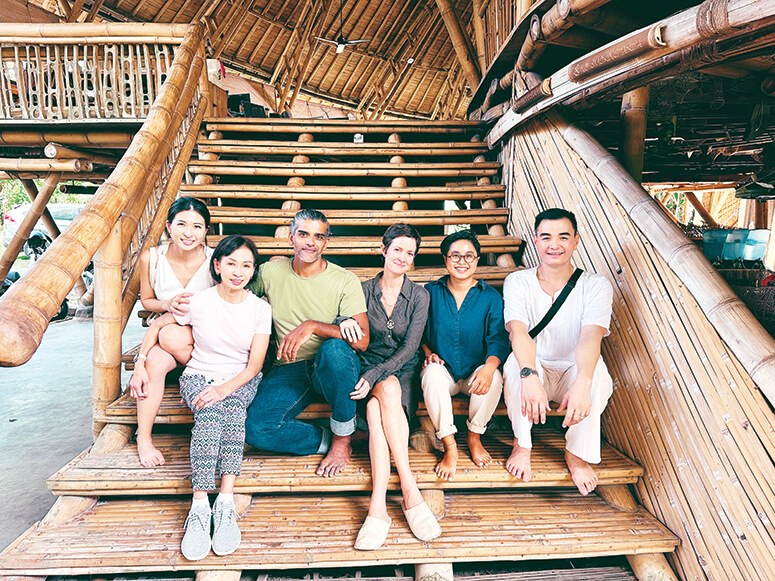
To bring this vision to life, CBDI partnered with Ibuku, the globally acclaimed bamboo design studio led by Elora Hardy as well as similarly lauded bamboo construction firm, PT Bamboo Pure led by her brother Orin Hardy. Known for transforming raw materials into lyrical structures, Hardy approached the Pavilion with quiet intention. “We aspire to design buildings that feel like they could only exist in that place,” she shares. “Bamboo isn’t just a material—it’s part of the land’s language.”
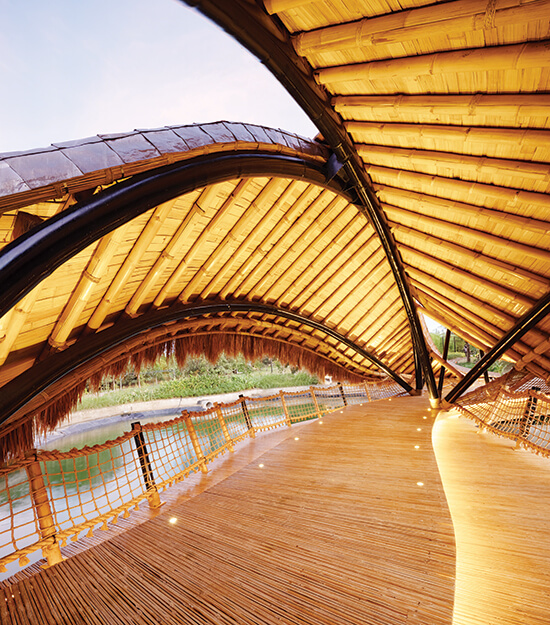
The Pavilion’s wide-span roof, made of layered thatch and framed by upward-sweeping bamboo poles, feels both grounded and uplifted. Hardy’s philosophy blends architecture with emotion: “We’re always trying to design spaces that help people feel more present, more aware of their surroundings. When a structure can do that, it becomes more than just a building—it becomes an experience.”
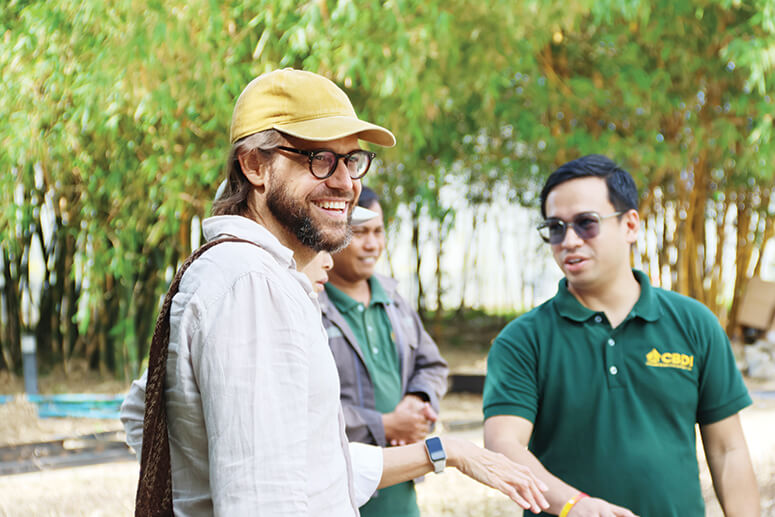
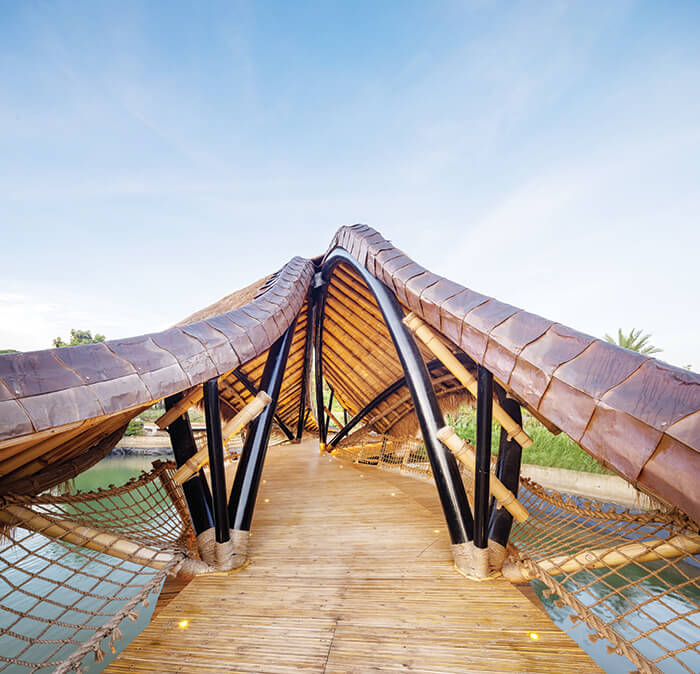
That experience was brought to life with the support of Filipino architects Christian Salandanan and Kath Sapungay of Sangay Architects, who oversaw the project’s local execution. “We weren’t just working with bamboo” Sapungay explains. “We were working with memory, climate, and community.” Confronted with the challenge of adapting a design for the Philippines’ extreme weather, their team collaborated with structural engineers at Atelier One to introduce a steel spine—a key innovation that ensured resilience without sacrificing grace. “We choreographed a partnership between bamboo and steel, where one flows and the other supports, both in harmony.”
Throughout the process, Sapungay remained focused on redefining how Filipinos see bamboo. “Our goal was to show bamboo as a symbol of strength, elegance, and permanence,” she says. “We anchored it onto stone pedestals and kept its natural form visible, to ground the structure both visually and symbolically.”
She also emphasized the importance of honoring local craftsmanship. “The process became a living exchange between Balinese artisans and our local builders,” she shares. “It wasn’t just construction—it was a workshop for passing on skills, techniques, and a deeper respect for bamboo as a contemporary building material.”
Kaway’an EcoPark isn’t just about design-forward spaces. It’s about reclaiming cultural identity through material honesty, craftsmanship, and collaboration. From local workers who trained alongside international artisans to children learning about bamboo farming and organic food production in weekend workshops, the park pulses with life—both natural and human.
As the EcoPark continues to expand its programming and reach, it aims to serve as a benchmark for what environmentally and culturally attuned development can look like in the Philippines. Plans are already underway for bamboo plantations, education centers, and community events that promote Filipino creativity and sustainable living.
By reframing bamboo not as a relic of the past, but as a building block for the future, Kaway’an EcoPark is helping shape a new narrative for Philippine development—one rooted in cultural pride, ecological balance, and architectural innovation.
#BrandedUp
