

We grew up during the height (or booming years) of G & W Architects, admiring and being motivated by Arch. Gilbert Yu’s creative and innovative approach to design and construction. His presence and dominance in designing and erecting vertical structures all over the country became an inspiration to us younger generation of architects, who knew about his works even as far as Mindanao, where I come from.
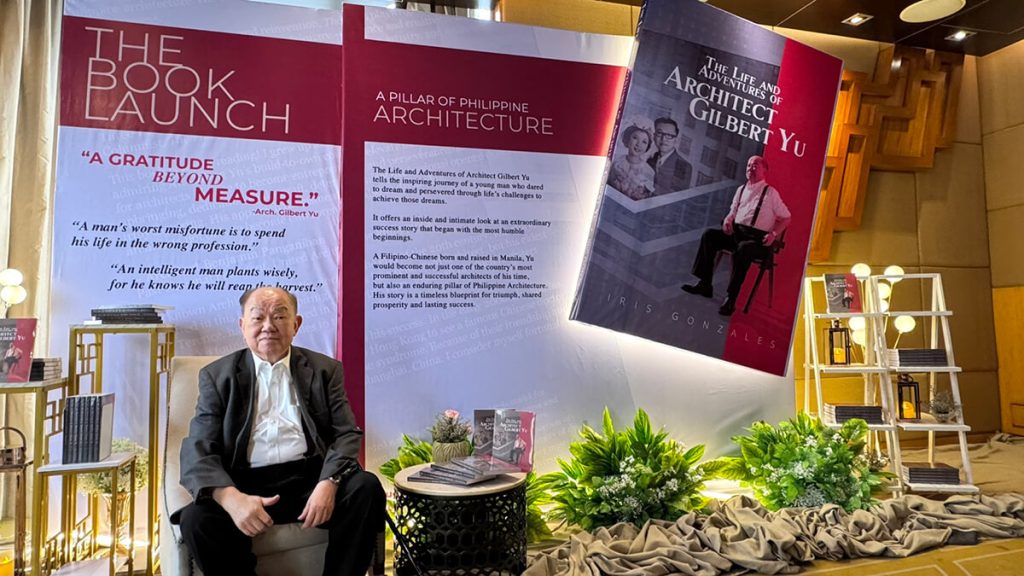
But what caught my eye at the launch of the biographical book “The Life and Adventures of Arch. Gilbert Yu” was the masterful and creative narrative crafted by the author, Ms. Iris Gonzales, Business Editor and Op-Ed columnist at the Philippine Star, who, as a multi-award-winning journalist, somehow rekindled my memories of Arch. Gilbert Yu’s inspiring and extraordinary approach to business as an architect. She significantly highlighted an important and integral part of Arch. Gilbert Yu’s life that awakened every architect’s dream of becoming bigger, managing their own business at the top of their construction firms, and at the same time expressing and managing their own creativity in design and construction, paving the way for them to embrace their profession, not just as employees but as visionary employers shaping bigger dreams.
Iris Gonzales is a graduate of the University of the Philippines College of Mass Communication and a Konrad Adenauer Fellow with a master’s degree in journalism from Ateneo de Manila University. She featured a chapter on the build-to-own concept, which to me was an important milestone in Arch. Yu’s career that eventually disrupted the marketing approach of selling properties and condominiums. This gave clients and technical professionals in the field of design and construction a comparative edge and affordability in building their dream houses and even condo units for clients through an alternative approach of home ownership.
Arch. Gilbert Yu’s pronouncement that every family should be able to afford a home, coupled with his creative and technical expertise in property development, showed his savvy approach to business and economics accentuated by the author in several examples that Arch. Gilbert Yu imparted to his children and office personnel.
Such examples were the change of approach in marketing property strategies, his vision of interrelating commercial properties with public transportation flow and even his outlook in satisfying clients on the use of their idle properties showed his in-depth analysis and forward-thinking business acumen.
The book is written in a way that inspires architects to overcome adversaries like Arch. Gilbert Yu did. Iris Gonzales depicted the humane side of the story, touching the lives of others to look back, learn from the past, and move forward in today’s world.
I became one of those following Arch. Gilbert Yu’s determination and dedication in uplifting the architectural profession, at the same time, taking a different outlook on practicing the profession as a business and property entrepreneur.
“The Life and Adventures of Architect Gilbert Yu” is a well-arranged and must-read book laid out by Iris Gonzales, who captured the humanitarian side and the upbringing of Arch. Gilbert Yu, his love for family, the emotional and human side of his practice, his resilience, and the perseverance of his extraordinary journey through life.
From zero to skyscrapers: Gilbert Yu’s blueprint for architects
Celebrated architect and developer Gilbert Yu distills more than three decades of experience into three lessons for the next generation of designers, shared in his new biography The Life and Adventures of Architect Gilbert Yu by Iris Gonzales.
Lesson 1: Architecture goes beyond design.
“Architecture is not just about designing structures—it’s about building lives,” Yu said. Every structure must have purpose, be designed with excellence, and built for permanence.
Lesson 2: Architects must be knowledgeable in business.
Yu believes architects should understand property value, project feasibility, and market trends. Architects, he stresses, must also be development consultants, not just technical people.
Lesson 3: Architects must be forward-thinking.
Designs should anticipate shifts in landscapes, lifestyles, and technology, enabling structures to stand the test of time.
“A project starts from zero before becoming an iconic landmark. With vision and dedication, architects can transform the impossible into reality,” Yu said, summing up his mantra: “Zero plus zero plus zero equals 100.”
#PropertyReportFeature
#FeaturedStory
